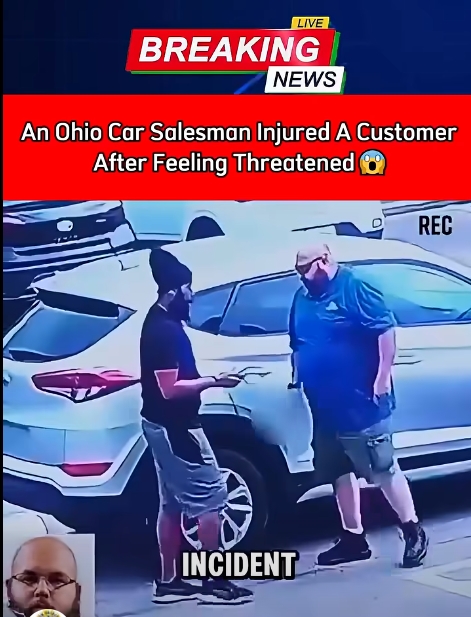
In recent years, Ohio has seen several disturbing incidents where car dealership employees have injured customers during confrontations that escalated dangerously. These cases raise fundamental questions about the use of force, the boundaries of self-defense, and whether a “feeling” of threat is sufficient justification for causing physical harm to another person. The answer, legally and ethically, is far more complicated than it might initially appear.
Perhaps the most extreme example occurred in Bedford, Ohio, in August 2022. Andrew Mach, an employee at Hyundai of Bedford, shot a customer following a dispute . According to investigators, an argument broke out between the customer and a service department employee. The employee claimed the customer reached toward his waistband, prompting him to draw his weapon and fire, striking the customer in the hip . First responders found the customer bleeding heavily in the parking lot; he was rushed to the hospital but survived . Crucially, police later stated they did not believe the customer was armed and found no weapon at the scene . Mach ultimately pleaded guilty to felonious assault and was sentenced to three years in prison .
Another case demonstrates that violence at Ohio dealerships is not limited to firearms. In Harrison Township, a customer called police after an employee mopping the floor stabbed him in the face following a heated argument. In a call to 911, the employee claimed he stabbed the customer in fear for his safety . And in a 2007 case, State v. Estep, an employee was charged with assault after pushing a customer to the ground in the dealership lot. The employee argued self-defense, claiming the customer was aggressive. The court, however, rejected this defense, noting that the employee left his desk to approach the customer and did not attempt to retreat—a key requirement for a valid self-defense claim .
These cases highlight a troubling pattern: employees reacting to perceived threats with disproportionate force, often with devastating consequences. The legal doctrine of self-defense is not a blank check. In Ohio, the law requires that a person claiming self-defense prove they were not at fault in creating the situation, that they had a genuine belief they were in imminent danger, and that they had no reasonable means to retreat . When an employee escalates a verbal dispute into physical violence—especially deadly violence—without attempting to de-escalate or withdraw, the self-defense claim becomes highly suspect.
The Bedford shooting is particularly instructive. The employee shot an unarmed customer. He had alternatives: he could have walked away, called security, or retreated to a safe location. Instead, he chose to use lethal force. The result was a guilty plea, a prison sentence, and a destroyed career. The customer, meanwhile, suffered a traumatic injury that will likely affect him for the rest of his life.
From an ethical standpoint, the dynamic at play is deeply concerning. Car dealerships are commercial environments where customers are entitled to express frustration, even heatedly. While no one should condone aggressive or threatening behavior, the response must be proportional to the threat. An employee’s “feeling” of being threatened, without objective evidence of imminent danger, should never justify inflicting serious injury on a customer. Dealerships have a responsibility to train their staff in conflict de-escalation, ensuring that disagreements are resolved through dialogue, not violence. The failure to do so not only endangers customers but also exposes the business and its employees to significant legal liability.
Ultimately, these incidents serve as a stark warning: feeling threatened is not the same as being in imminent danger. The law demands more than a subjective sense of fear; it requires a reasonable belief that harm is about to occur. When employees cross that line, they must face the consequences.
@luleyxmpt7t